
Build vs Buy: Why Modern Lenders Should Rethink Building Their Lending Stack
Building a lending stack in-house used to make sense. But as lending becomes an infrastructure problem, the build-vs-buy equation has fundamentally changed.
Daman Singh Kohli
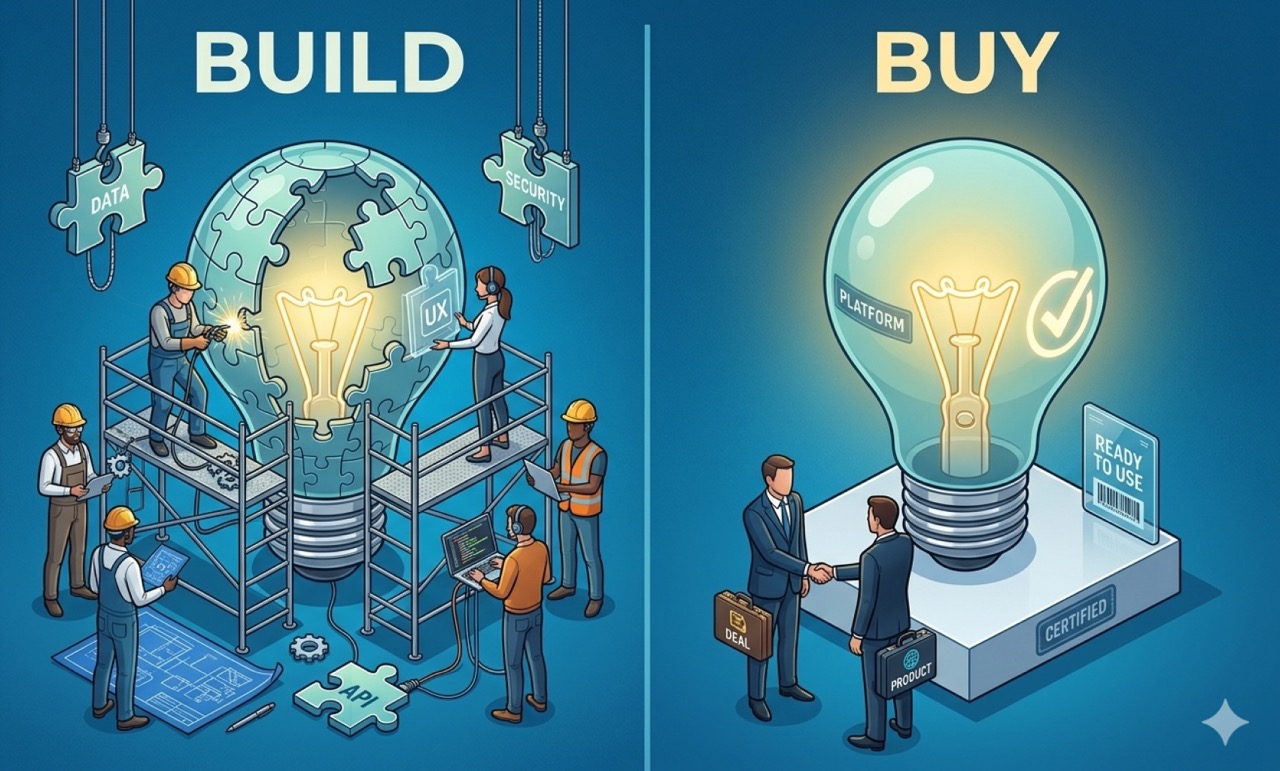
Every lender eventually faces the same question: should we build our lending stack in-house, or buy it from a technology service provider?
A few years ago, building internally often felt like the right answer. Lending products were relatively stable, regulatory change was slower, and systems were expected to support a narrow set of workflows. Owning the stack felt like owning control.
That reality has changed.
Lending today is no longer a static product business. It is a constantly evolving infrastructure problem. Credit models change, partnerships shift, regulatory expectations tighten, and new products need to be launched quickly. In this environment, the build versus buy decision looks very different.
Historically, internal builds worked because the cost of change was low. Engineering teams could build an LOS or LMS, customise it over time, and keep it running without major disruption. Integrations were limited, audits were infrequent, and time-to-market was not a competitive advantage.
Modern lending doesn’t work that way.
Today, lenders are operating in a world shaped by frequent regulatory updates, co-lending and partner-led models, and heavy reliance on external APIs for KYC, bureau, banking, and collections. Systems must be configurable, audit-ready, and resilient to change. Hard-coded workflows and one-off builds struggle under this pressure.
The real challenge with building in-house is not the initial effort—it’s the long-term cost. Internal teams end up spending increasing time reworking flows for new products, adjusting systems for regulatory changes, and managing technical debt created by quick fixes. Over time, engineering teams become reactive, business teams slow down, and innovation gets constrained by past architectural decisions.
At some point, the lending stack stops being a competitive advantage and starts becoming a bottleneck.
One insight we’ve seen repeatedly is that building and maintaining a modern lending stack is a full-time business in itself. It requires continuous investment in domain expertise, architecture, security, and compliance. For most lenders, this is not where their real advantage lies. Their strength is in understanding risk, managing capital, building distribution, and serving customers—not in rebuilding infrastructure every time the ecosystem shifts.
This is why the idea of "buying" looks very different today than it did earlier.
Modern technology service providers are no longer offering rigid, off-the-shelf products. The better platforms are built to be configurable and adaptable, allowing lenders to evolve without rewriting core systems. Business and risk teams can own configuration, while the underlying infrastructure keeps pace with regulatory and ecosystem changes.
At Crego, we built the platform with this mind shift. We believe lenders shouldn’t have to bend their business around software limitations. The lending stack should adapt as products, partnerships, and regulations evolve. Our focus is on building and maintaining that infrastructure, so lenders can focus on lending.
The build versus buy decision is no longer about control versus convenience. It’s about focus.
In a world where lending requirements change faster than internal roadmaps, building everything in-house often turns out to be the more expensive and riskier option. Buying from a specialised TSP allows lenders to move faster, stay compliant, and scale without accumulating long-term technical debt.
For modern lenders, the real question isn’t whether they can build their lending stack. It’s whether they should.